


Business operations are changing rapidly. Companies no longer rely solely on local hires. Scaling effectively now requires a global talent strategy. Decision-makers are prioritizing agility and cost-efficiency for that.
The easiest way to access global talent with cost-efficiency is through virtual assistants. In fact, they have become the go-to solution for most modern enterprises. This has led the virtual assistant global market to reach around $92.29 billion by the end of 2029, as per market analysis.
But plenty of businesses still raise a question: Is the virtual assistant cost truly worth it? That’s what we are going to break down in this guide. We will take a deep dive into the cost of hiring a virtual assistant in 2026. Let’s get going.
Why Do Businesses Outsource to Virtual Assistants?
Outsourcing to virtual assistants allows businesses to handle tasks efficiently, reduce costs, and access flexible support. It lets teams focus on high-value work while easily scaling support as needs change.
- Measurable ROI: VA work is usually task-based and time-tracked, so it becomes easier to compare cost versus result. Businesses can see hours saved, faster execution and also how leadership time get redirected toward revenue work.
- Scalability & Flexibility: Support can expand during growth periods or reduce when priorities change. There’s no long recruitment cycle and you are not locked into capacity you may not use later.
- Faster Turnaround & Extended Coverage: With offshore and distributed setups, progress often continues after local teams log off. That overlap helps shorten delivery timelines and keeps operations moving more continuously.
- Quality & Process Reliability: When assistants follow documented SOPs and repeat workflows every day, variation tends to decrease. After a few weeks they usually understand internal tools deeply and need less correction.
- Access to Specialized Skills on Demand: Instead of hiring niche experts full time, companies bring in targeted capability only when required. This keeps budgets lighter while still giving access to professional level execution.
How Much Does a Virtual Assistant Cost?
The cost of a virtual assistant varies significantly. Prices depend on location, expertise, and service models.
Average Hourly Rates
Hourly rates allow for high flexibility. They are perfect for small tasks or variable workloads. This can be categorized based on the expertise required for the tasks and the location of the virtual assistant.
| Skill Level | Offshore | Nearshore | Domestic |
|---|---|---|---|
| Entry-Level | $2 – $8 | $8 – $15 | $12 – $25 |
| Experienced | $8 – $18 | $15 – $30 | $25 – $50 |
| Specialized | $15 – $35 | $25 – $50 | $50 – $100+ |
Average Monthly / Full-Time Costs
Monthly retainers provide stability for both parties. Agencies often package these into tiered plans. The pricing of these plans will again depend on the expertise as well as the location of the service provider.
Part-Time Engagement
Here’s a table that breaks down part-time engagement for virtual assistant services. These values are based on 20 hours per week.
| Region | Entry-Level | Experienced | Specialized |
|---|---|---|---|
| US-Based | $1,000-2,000/month | $2,000-4,000/month | $4,000-8,000/month |
| Latin America | $640-1,200/month | $1,200-2,400/month | $2,000-4,000/month |
| Philippines | $240-640/month | $640-1,440/month | $1,440-2,800/month |
| Bangladesh | $160-640/month | $640-1,200/month | $1,200-2,000/month |
Full-Time Engagement
The following values are based on a 40-hour per week full-time engagement for a virtual assistant.
| Region | Entry-Level | Experienced | Specialized |
|---|---|---|---|
| US-Based | $2,000-4,000/month | $4,000-8,000/month | $8,000-16,000/month |
| Philippines | $480-1,280/month | $1,280-2,880/month | $2,880-5,600/month |
| Bangladesh | $320-1,280/month | $1,280-2,400/month | $2,400-4,000/month |
| Latin America | $1,280-2,400/month | $2,400-4,800/month | $4,000-8,000/month |
Hidden & Additional Costs
The quoted hourly or monthly rate rarely represents the total investment. Smart budgeting accounts for these often-overlooked expenses:
Training Investment
New VAs require 10-30 hours of training regardless of experience level. This includes tool access setup, process documentation review, communication protocol establishment, and supervised task execution. At $50/hour internal cost for training time, that’s $500-1,500 in organizational resources per VA.
Management Time
Effective VA relationships require ongoing oversight. Plan for 2-5 hours weekly for task assignment, quality review, feedback sessions, and strategic alignment. For managers earning $75,000 annually ($36/hour), that’s $300-750 monthly in management cost per VA.
Software & Tools
VAs need access to your tech stack. Common monthly costs include:
- Project management (Asana, Monday.com): $10-25/user
- Communication (Slack Premium, Zoom): $8-15/user
- CRM access (HubSpot, Salesforce): $45-150/user
- Design tools (Canva Pro, Adobe): $13-55/user
- Password management (1Password, LastPass): $5-8/user
- Total software overhead: $80-250/month per VA, depending on role requirements.
Agency Fees
The VAs hired by the agencies come with recruitment fee, replacement and account management. The anticipated price difference will be 20-40% higher than direct-hiring rates, with a lessened burden on the management and swifter changeover in the occasion of fit problems.
Top 10 Virtual Assistant Cost Comparison
The practical pricing of the providers is used to tune the budget expectations. These are the existing companies in the market in terms of service models and geographic specialization.
| S.N | Company Name | Starting Plan | Hourly Estimate (USD) | Region/Base |
|---|---|---|---|---|
| 1. | Green Feather Technologies | Custom pricing | $6 – $15 | Bangladesh |
| 2. | Belay | $1,200-3,000/month | $38 – $45 | US |
| 3. | Prialto | $1,450/month (55 hrs) | $25 – $35 | Global |
| 4. | Boldly | $2,520/month (40 hrs) | $55 – $79 | US/Global |
| 5. | Virtual Coworker | Custom pricing | $8 – $20 | Philippines |
| 6. | Time Etc | $390/month (10 hrs) | $35 – $38 | US/UK |
| 7. | Zirtual | Tiered plans | $45 – $55 | US |
| 8. | Woodbows | ~$1,500/month | $17 – $31 | Philippines |
| 9. | ARC (Arc.dev) | Pay-per-hour | $40 – $100+ | Global marketplace |
| 10. | MyOutDesk | $1,988/month | $12 – $20 | Philippines |
What Are the Factors That Affect Virtual Assistant Costs?
Knowing the price drivers will assist you in making judgments on the prices and prevent paying too much to get capabilities that you do not require.
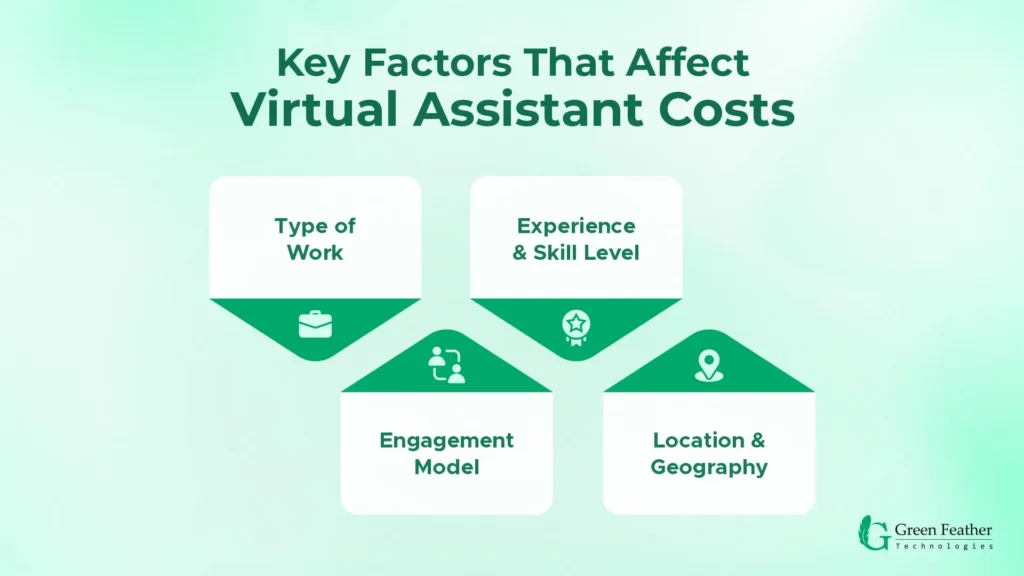
Type of Work
The prices of a virtual assistant do not come out of thin air. Several variables interact to create your real price. Being aware of these variables will help you to view quotes in the correct light and not waste money.
- Administrative work: The cost of administrative work is usually $5-20/ hour, as it is conducted through standard procedures and does not need any specialized knowledge. These include email management, calendar scheduling, data entry, and travel booking.
- Executive assistance: The cost of executive assistance is between 18 and 45/hour since it involves judgment, discretion, and business skills that go beyond instruction.
- Marketing: Marketing support will cost between 15 and 60/hour based on the skills of the individual. Social media scheduling is on the lower extreme, whereas the campaign strategy and analytics work move towards the higher end.
- Sales: The cost of sales support VAs is 20-50/hour due to the direct implication on revenue generation. The concepts of sales processes and buyer psychology are needed in lead research, CRM management, appointment setting, and proposal preparation.
- Customer Support: The roles of customer support depend on complexity and fall within the range of $10-30/hour. Simple responses to tickets are inexpensive compared to technical problems, troubleshooting, or responding to complaints that are escalated.
- Bookkeeping: The cost of bookkeeping is 25-65/hour because it is mandatory, and the accuracy of finances is involved. Invoice handling, cost management,t and reconciliation have actual implications to business finances and taxation adherence.
- Technical Roles: Technical positions attract the highest rate of 30-100/hour due to the inadequacy of skills. WordPress administration, some code, setting up automation, and 3rds are under certain technical certifications and experience that fewer VAs have.
| Role | Est. Hourly Rate (2026) | Key Focus Area |
|---|---|---|
| Administrative | $5 – $20 | Email, calendar, and data entry. |
| Executive Assistant | $18 – $45 | High-level coordination and judgment. |
| Marketing Support | $15 – $60 | Social media, strategy, and analytics. |
| Customer Support | $10 – $30 | Troubleshooting and ticket responses. |
| Bookkeeping | $25 – $65 | Financial accuracy and reconciliation. |
| Technical Roles | $30 – $100 | Automation, coding, and integrations. |
Experience & Skill Level
Experience level creates substantial price variation even within the same task category. Here’s a quick breakdown based on different levels of experience for VAs.
- Junior VAs: These entry-level assistants cost less but need detailed instructions and frequent reviews.
- Mid-level VAs: Experienced assistants work independently and troubleshoot issues without constant hand-holding.
- Senior VAs: These pros proactively manage complex projects and anticipate your needs before you ask.
- Specialized VAs: Rare experts command premium rates by delivering high-value results in niche fields.
| Level | Pricing Factor | Key Value Proposition |
|---|---|---|
| Junior (0–2 yrs) | Baseline Rate | Requires detailed instructions and checks. |
| Mid-level (3–5 yrs) | 1.5x – 2x Baseline | Operates independently with less oversight. |
| Senior (6+ yrs) | 2x – 3x Baseline | Acts as a force multiplier and strategist. |
| Specialized | 3x – 5x Baseline | Niche expertise (e.g., fractional CFO). |
Engagement Model
How you structure the working relationship fundamentally affects both your direct costs and hidden expenses that impact total investment.
- Hourly Model: This model offers maximum flexibility by charging only for tracked time, though it requires more oversight for reviewing invoices and timesheets.
- Part-time Model: Part-time retainers provide budget predictability and small discounts for consistent support ranging from 10 to 20 hours per week.
- Full-time Model: Committing to a 40-hour week secures the lowest possible per-hour rate through significant volume discounts and long-term stability.
- Project-Based Model: This model uses a flat fee for specific deliverables, giving you total cost certainty regardless of the time required to finish.
- Retainer Models: Retainer models offer a middle ground with minimum monthly commitments and rollover hours to handle fluctuating workloads efficiently.
| Model | Cost Impact | Best For |
|---|---|---|
| Hourly Model | Standard rate | Variable or short-term needs. |
| Part-time (10–20 hrs) | 10% – 15% Discount | Consistent, limited-scope workflows. |
| Full-time (40 hrs) | 15% – 25% Discount | Ongoing daily business operations. |
| Project-Based | Flat Fee | One-time deliverables with clear scopes. |
| Retainer Model | Fixed monthly fee | Predictability with rollover flexibility. |
Location & Geography
Geography is the main factor in virtual assistant pricing. US hires provide native fluency and perfect time zone alignment. The Philippines and Bangladesh offer the lowest global rates. Latin America and Eastern Europe provide specialized skills and proximity.
Sourcing from Asia maximizes savings but creates time zone friction. Nearshore options like Latin America cost more but allow live collaboration. Choose your region based on whether you value extreme budget efficiency or immediate communication and support.
Get a breakdown of the virtual assistant cost based on location in the table below.
| Region | Cost Level | Main Advantage |
|---|---|---|
| United States | High ($25 – $75) | Native fluency and perfect time alignment. |
| Philippines | Low ($3 – $15) | Strong English skills and a mature industry. |
| Bangladesh | Lowest ($3 – $10) | High technical talent at a high-ROI price. |
| Latin America | Mid ($9 – $25) | Nearshore overlap with U.S. business hours. |
| Eastern Europe | Mid ($10 – $25) | Strong IT, technical, and multilingual skills. |
Comparing Virtual Assistant Costs
Context determines whether a VA investment makes financial sense. Direct comparison against alternatives reveals true value.
In-House Employee vs Virtual Assistant
Full-time employees carry substantial costs beyond base salary. Virtual assistants eliminate most of these fixed expenses while providing comparable output for many roles.
According to the U.S. Bureau of Labor Statistics, benefits averaged 29.8% of total compensation for private industry workers in June 2025.
| Cost Category | In-House Employee | Virtual Assistant | Difference |
|---|---|---|---|
| Base Compensation | $45,000-65,000/year | $15,000-35,000/year | 60-70% savings |
| Employer Taxes (7.65% FICA) | $3,500-5,000/year | $0 | 100% savings |
| Health Insurance | $18,500/year | $0 | 100% savings |
| Retirement Match (3-5%) | $1,350-3,250/year | $0 | 100% savings |
| Paid Time Off (15-20 days) | $2,600-5,000/year | $0 | 100% savings |
| Equipment & Office Space | $5,000-12,000/year | $0-500/year | 90-95% savings |
| Training & Development | $1,000-3,000/year | $500-1,500/year | 50-70% savings |
| Total Annual Cost | $76,950-111,750 | $15,500-37,000 | 67-75% savings |
A mid-level administrative employee with a salary of $50,000 expenses $76950 – $86750 with a full package of benefits, which is about 30 percent of pay. The same functional capability with a full-time VA would cost $20000 – $30000 in a year, and this would translate to an annual saving of $46950 – $60750.
ROI Calculation Example
The executive assistant (VA) employed by the company is a full-time employee as opposed to the in-house worker earning $65,000/month:
- Direct cost savings: $65,000 – $28,800 = $36,200
- Benefits savings: $20,000 (taxes, insurance, retirement, PTO)
- Office/equipment savings: $8,000
- Total first-year savings: $64,200
- Installation expenses (training, software): -$3,000
- Net first-year ROI: $61,200
The released-up executive has an extra 15 hours each month, and 180 hours in a year. At replacement value, this is an additional $27,000 of the revenue-generating work capacity. Combined value creation: year one, $88200.
Freelance vs Agency VA
Direct freelancer hiring offers lower costs but transfers risk and management burden. Agencies charge premiums for infrastructure and guarantees.
| Factor | Freelance VA | Agency VA | Impact |
|---|---|---|---|
| Hourly Rate | $10-50/hour | $15-75/hour | 20-50% premium |
| Vetting | Self-managed | Pre-screened | Time savings vs. upfront cost |
| Replacement | Find & train new VA | The agency provides backup | Business continuity risk |
| Management | Direct oversight required | Account manager included | Internal resource allocation |
| Quality Guarantee | None (individual basis) | Service level agreements | Risk mitigation |
| Scalability | Hire individually | Rapid team expansion | Growth flexibility |
| Payment Structure | Invoice individual | Single invoice | Administrative efficiency |
Freelancers make sense for established businesses with an HR infrastructure and clear VA management processes. You save 20-40% on rates but assume all recruitment, vetting, and replacement risk.
Agencies justify their premium for companies without dedicated operations managers. You pay more per hour but eliminate recruitment time, gain rapid replacement for poor fits, and access account management that reduces your internal oversight burden.
How to Calculate Your Virtual Assistant Costs?
Accurate budgeting requires systematic analysis of your specific needs and operational context.
Steps to Calculate Costs
Follow this framework to estimate a realistic VA investment:
Step 1: Define Tasks & Scope
List every task you plan to delegate. Categorize by:
- Frequency (daily, weekly, monthly, quarterly)
- Time required per occurrence
Skill level needed (entry, experienced, specialized) - Urgency (real-time vs. asynchronous acceptable)
Example breakdown:
- Email management: 30 min daily = 2.5 hrs/week (entry-level)
- Social media scheduling: 3 hrs/week (experienced, marketing)
- Bookkeeping: 5 hrs/month (specialized, certified)
- Research projects: 4 hrs/week (experienced)
- Total: 13 hrs/week regular + 1.25 hrs/week bookkeeping = 14.25 hrs/week average
Step 2: Determine Engagement Model
Based on task volume:
- Under 10 hrs/week: Hourly or project-based
- 10-25 hrs/week: Part-time retainer
- 25-40 hrs/week: Full-time dedicated VA
- 40+ hrs/week: Multiple VAs or team structure
For 14.25 hrs/week, a part-time retainer makes sense (15-20 hrs/month commitment).
Step 3: Decide Location
Evaluate time zone needs and budget constraints:
| Priority | Recommended Region | Rate for 15 hrs/week |
|---|---|---|
| Maximize savings, async work acceptable | Bangladesh | $480-960/month |
| Balance cost & time zones | Philippines | $480-1,080/month |
| Real-time collaboration required | Latin America | $960-1,800/month |
| US hours mandatory, high-stakes work | United States | $1,500-3,000/month |
In our case, when the tasks are mostly asynchronous, the best value is given by Bangladesh or the Philippines, with an average of $600-800/month.
Step 4: Include Software, Tools, and Overhead
Add required tool access:
- Project management (Asana): $12/month
- Communication (Slack): $8/month
- Social media scheduling (Buffer): $15/month
- Password manager (1Password): $7/month
- Total tools: $42/month
- Add training time: 15 hours × $40/hour internal cost = $600 one-time
- Add management time: 3 hours monthly × $60/hour = $180/month ongoing
Step 5: Calculate Total Investment
Monthly recurring cost:
- VA fees: $700
- Software: $42
- Management time: $180
- Monthly total: $922
First-year total:
- Setup (training): $600
- Monthly costs × 12: $11,064
- Year one total: $11,664
- Effective hourly rate: $11,664 ÷ (15 hrs/week × 52 weeks) = $15/hour fully loaded
Cost Savings Calculator
Use this formula to estimate your savings versus in-house alternatives:
Input Variables:
- Hours needed per week: H
- VA hourly rate by region: R
- Equivalent in-house hourly cost: I (salary + benefits + overhead ÷ 2,080 annual hours)
- Software overhead per month: S
- Management hours per month: M
- Manager hourly cost: C
Monthly Cost Formula:
- VA Total Cost = (H × 4.33 × R) + S + (M × C)
Annual Savings Formula:
- Annual Savings = (H × 52 × I) – [(H × 4.33 × R × 12) + (S × 12) + (M × C × 12)]
Example Calculation:
- H = 20 hours/week
- R = $15/hour (Philippines, experienced VA)
- I = $40/hour (equivalent in-house fully loaded based on BLS compensation data)
- S = $75/month (software access)
- M = 4 hours/month (management time)
- C = $65/hour (manager cost)
Monthly VA cost = (20 × 4.33 × $15) + $75 + (4 × $65) = $1,299 + $75 + $260 = $1,634
Annual in-house cost = 20 × 52 × $40 = $41,600
Annual VA cost = $1,634 × 12 = $19,608
Annual savings = $41,600 – $19,608 = $21,992
ROI = $21,992 ÷ $19,608 = 112% return on investment
Affordable & Cost-Effective Virtual Assistant Options
VA benefits are not being killed by budget limitations. The models of strategic sourcing and engagement render quality support available at different prices.
Low-Cost Virtual Assistants
Entry-level VAs from offshore markets start around $5-8/hour. These options work well for specific scenarios but carry trade-offs to be evaluated carefully.
Best Use Cases:
- High-volume data entry or processing
- Social media content scheduling (not creation)
- Basic research and information gathering
- CRM data updates and maintenance
- Email inbox organization and filtering
Risk Factors:
- Higher error rates initially require quality checks
- A limited business context means detailed instructions are needed
- Communication may require extra clarity and patience
- Less initiative in problem-solving or process improvement
- Higher turnover risk increases training frequency
Trade-off
A VA with a cost of 5 per hour, requiring 8 hours to finish the work, a VA with a cost of 20 per hour finishes the work in 3 hours and has the same cost (40) but takes a longer turnaround time. But on jobs that do not require speed, the low hourly rate will enable you to outsource more volume without budget constraints.
Startups that have more time than money can use low-cost VAs to do low-cost and routine tasks as founders concentrate on revenue generation. Older companies must reserve the low-cost options for the high-volume, low-stakes work instead of the mission-critical operations.
Cost-Effective VA Services
Value providers strike an optimal price-quality ratio by running lean operations and savvy matching, as opposed to low prices.
The features of Cost-Effective Services:
- Structured onboarding reduces training time
- Clear process documentation standardizes output
- Quality management catches errors before delivery
- Backup coverage prevents productivity gaps
- Volume discounts for multiple VAs or increased hours
Package vs. Hourly Pricing
Packages create predictability and often include value-adds:
- 40 hours/month at $480 ($12/hour effective) vs. $15/hour ad hoc
- Included project management and reporting
- Guaranteed response times
Monthly strategy calls with the account manager - The premium over the absolute lowest rates covers operational efficiency and risk reduction.
ROI-Focused Approach
Rather than optimizing for the lowest cost per hour, optimize for the highest output per dollar. An $18/hour experienced VA who completes tasks correctly the first time delivers better ROI than $8/hour junior VA requiring 3 revision cycles and 2 hours of your management time per week.
Calculate value as: (Output Quality × Task Volume) ÷ Total Cost
Low Cost vs Value Focused VA packages
The decision to opt at lowest price as opposed to the best value depends on your stage of business. The following is a comparison that you can use to decide which model best meets your present requirements.
| Feature | Low-Cost Virtual Assistants | Value-Focused VA Packages |
|---|---|---|
| Starting Rate | $5 – $8 per hour | $12 – $18 per hour (Effective) |
| Best Use Cases | Data entry, basic research, and simple scheduling. | Marketing, technical support, and project management. |
| Core Characteristics | Tasks require highly detailed instructions and oversight. | Includes structured onboarding and quality management. |
| Primary Benefits | Extremely low budget strain for high-volume work. | Predictable costs, backup coverage, and higher output. |
| Risk Factors | Higher error rates and increased turnover risk. | Higher initial hourly rate compared to entry-level. |
| Management Needs | Requires daily supervision and frequent quality checks. | Managed by agencies like Green Feather Technology. |
| ROI Strategy | Focuses on minimizing the cost per hour. | Concentrates on getting maximum output using the minimum amount of money. |
Cost-Saving Tips When Hiring Virtual Assistants
The strategic approaches to VA engagement are cost-reducing and do not compromise the quality and output
- Define Scope Clearly: Create clear process documents with screenshots and success criteria to prevent time wastage. Every hour you spend documenting saves ten hours of redoing work and reduces your management overhead.
- Start Part-Time: Begin with 10–15 hours weekly to refine your processes and minimize financial risk. Only scale to full-time after a few months of consistent success to avoid paying for unused capacity.
- Choose the Right Region: Select your VA’s location based on specific task needs rather than default settings. Use nearshore talent for real-time support and offshore hubs like Bangladesh for high-value administrative or technical work.
- Use Agencies for Scalability: Agencies prevent operational stops by providing immediate backup coverage if your primary VA is unavailable. This slight price premium acts as essential insurance against business disruption as your team grows.
- Document Processes Early: Record video demonstrations and step-by-step guides at the start of training to build a permanent knowledge base. This one-time investment ensures consistent quality and eliminates the cost of repeated training for future hires.
How to Get Started with a Virtual Assistant?
Systematic onboarding sets the foundation for successful VA relationships and maximizes ROI from day one.
- Assess Your Needs: Begin with the auditing of your calendar. Find repetitive, time-consuming, or low-risk work. Document these first. Do not outsource everything immediately. Begin with three basic tasks and increase them when your assistant demonstrates his/her competence.
- Choose a Hiring Model: Choose between an agency and a freelancer. There are freelancers who save on money and are highly vetted and managed. Agencies are prompt and more reliable. Select an agency if you prefer to receive backup protection and expert management initially.
- Select a VA or Partner: Consider agencies depending on geographic focus and specializations. Find honest companies that provide pre-vetted and high ROI talent. In case of freelancer hiring, see their portfolios and testimonials. Make sure that they overlap with your needs, timezone-wise.
- Onboarding & Integration: Spend the first week setting up tools and permissions. Move to core task training in weeks two and three. Use screen sharing to demonstrate workflows. By week four, validate their quality and gradually add new responsibilities to their plate.
- Documentation & Scaling: Create a central repository for all your processes and guidelines. This library helps you scale to more assistants without retraining from scratch. It maintains consistency. A good base will enable you to quantify productivity and see new areas of growth.
Conclusion
In conclusion, a virtual assistant will cost you between $5-15/hour of offshore entry-level support to $50-100/hour of US-based expertise. They will be based on such factors as the complexity of tasks, the level of experience, the model of engagement, and the geographic position.
Match your VA selection to operational needs rather than just minimizing costs. There’s no one solution for everyone. It will depend on what your business specifically requires. See what tasks you need help with, determine a budget for that, and then evaluate the ROI to find its worthiness for your business.
Reduce 60-75% of your costs while maintaining quality with Green Feather Technologies virtual assistant services. Book a call and check for yourself.
Frequently Asked Questions
How much does a virtual assistant cost per hour?
Depending on skill and the location, VA rates are between $5 and $100 + per hour. Offshore administrative VAs can range in price from $3-12/hour, experienced VAs $15-35/hour, and specialized (bookkeeping, marketing, tech) positions $40-100/hour, particularly US-based.
What is the average monthly cost of a virtual assistant?
Monthly costs range from $1,200 to $4,500. The price of part-time VAs is between $400 and $2,000/month, and full-time VAs are between $800 and $4,000/month. Full-time positions that are specialized may go up to $3,000-$8,000/month.
Are virtual assistants cheaper than in-house employees?
Yes. VAs are 65-75% cheaper than in-house workers because they save benefits, taxes, office space, and overhead. There is a typical full-time VA that can cost $18,000-35,000/year, as compared to $76,000 and above spent on an equivalent employee.
What is the most affordable way to hire a VA?
The cheapest would be the direct employment of offshore VAs on the freelance websites. The cheapest VAs are based in Bangladesh, and they cost about 5-8/hour. Direct recruitment eliminates agency fees, and a part-time initial hire will mean low monthly expenses, but it is also likely to demand additional management.
How do I calculate ROI from a VA?
ROI = (Value Created − VA Cost) ÷ VA Cost. Value involves saved time, revenue earned, and mistakes prevented. Ex: 40 hours of freeing a month at a value of $150/hour at VA with a price of $2,000/month will bring about a 200 percent monthly ROI.
Are there hidden costs?
Yes. Base VA rates are usually increased by 30-50 per cent for training, management time, and software. Average training on expectations, continuing management, and tools. Agencies add a 20–40% premium.