
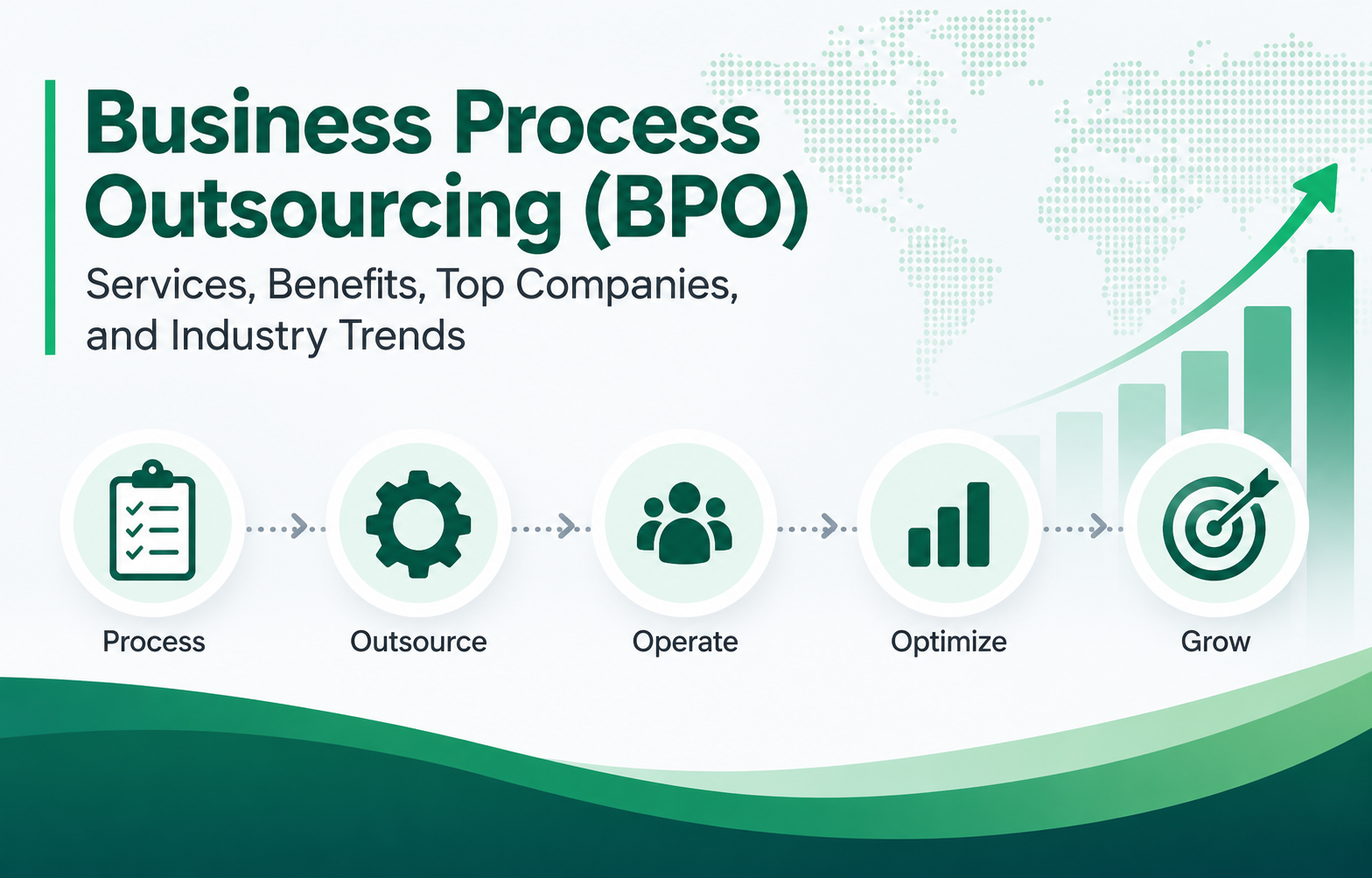

Business Process Outsourcing (BPO) has evolved into one of the most important strategies for modern businesses.
What started as a way to reduce labor costs has now become a powerful driver of efficiency, scalability, and digital transformation.
Companies today don’t just outsource to save money, they do it to move faster, access better talent, and stay competitive.
In this guide, you’ll learn what BPO is, how it works, the different types, benefits, risks, and the top companies shaping the global outsourcing landscape.
Introduction to Business Process Outsourcing (BPO)
Business Process Outsourcing refers to the practice of delegating specific business functions to external service providers.
These are typically non-core activities that can be handled more efficiently by specialized teams with the right tools and expertise.
Over time, BPO has expanded into almost every business function, from customer service to advanced analytics.
- What is a BPO provider?
A BPO provider is a third-party company that manages specific business operations on behalf of another organization.These providers bring trained teams, structured processes, and advanced technologies to handle tasks more efficiently than in-house teams. Instead of building everything internally, companies rely on BPO providers to execute operations at scale.
This allows businesses to focus their internal resources on growth, strategy, and innovation.
- Is BPO profitable?
Yes, BPO is a profitable business model because it operates on economies of scale. Providers serve multiple clients, optimize processes, and use automation to reduce costs while maintaining margins.At the same time, clients benefit from lower operational expenses and improved efficiency. This mutual value creation makes BPO a sustainable and growing industry globally.
Business Process Outsourcing Services Overview
BPO services cover a wide range of functions that businesses need to operate daily. These services have expanded significantly over the years, moving from basic administrative work to highly specialized and technical processes.
Core services in BPO
BPO companies typically handle:
- virtual assistance
- digital marketing
- data entry
- customer support
- finance and accounting
- HR
- IT services
These functions are essential but often repetitive and resource-intensive, making them ideal for outsourcing.
By transferring these responsibilities to external experts, companies can improve accuracy and turnaround time. Additionally, modern BPO providers integrate automation to further enhance performance and reduce manual effort.
Why Companies Outsource Business Processes
Average hourly rate range
Businesses outsource for strategic reasons that go beyond cost savings. It allows them to operate more efficiently while focusing on their core strengths.
- Cost reduction and efficiency
Outsourcing reduces expenses related to hiring, training, infrastructure, and management. Instead of building large internal teams, companies can leverage the provider’s existing setup and expertise.This leads to faster execution and fewer operational inefficiencies. Over time, the savings can be reinvested into growth initiatives.
- Scalability and flexibility
Workloads fluctuate, and outsourcing allows companies to scale operations up or down quickly. This flexibility is especially valuable during peak seasons or rapid growth phases.Businesses don’t need to worry about long-term commitments or underutilized resources. Instead, they can adapt their operations based on real-time needs.
- Access to global talent and technology
BPO providers offer access to skilled professionals from around the world. They also invest in advanced technologies like AI, automation, and cloud platforms.This gives companies capabilities they might not have internally. As a result, outsourcing becomes a way to upgrade both talent and technology simultaneously.
Types of BPO Services
BPO services are categorized based on the type of work being outsourced and its complexity.
- Back-office BPO
This includes internal operations like accounting, payroll, HR, and data management. These tasks are essential for business functioning but do not directly interact with customers.Outsourcing them improves efficiency and reduces administrative burden. It also ensures consistency and compliance in critical processes.
- Front-office BPO
These are customer-facing services such as support, sales, and technical assistance. They directly impact customer experience and brand perception.BPO providers specialize in handling large volumes of interactions while maintaining quality. This helps businesses deliver better service without building large in-house teams.
- Knowledge Process Outsourcing (KPO)
KPO involves high-skill tasks like research, analytics, and consulting. These require specialized expertise and domain knowledge.Companies outsource these functions to gain deeper insights and improve decision-making. It represents a shift toward more value-driven outsourcing.
Benefits of Business Process Outsourcing
The advantages of outsourcing extend across multiple areas of business performance.
- Improved efficiency and speed
BPO providers use optimized workflows and automation tools to complete tasks faster. Their experience across industries allows them to implement best practices quickly.This reduces turnaround time and increases overall productivity. Businesses benefit from faster operations without compromising quality.
- Enhanced customer experience
Outsourcing customer support ensures consistent and high-quality service. Many providers offer 24/7 support across multiple channels, improving accessibility.This leads to higher customer satisfaction and retention. A better customer experience directly contributes to business growth.
- Focus on core business functions
By outsourcing non-core tasks, companies can concentrate on strategic priorities. Internal teams can focus on innovation, product development, and market expansion.This improves overall business performance and competitiveness. Outsourcing essentially frees up time and resources for higher-value activities.
Risks and Challenges of BPO
While BPO offers many benefits, it also comes with certain risks that need to be managed carefully.
- Data security and compliance risks
Sharing sensitive information with third-party providers can create security concerns. Companies must ensure that providers follow strict compliance standards and data protection protocols.Failure to do so can lead to legal and reputational issues. Proper due diligence is essential before selecting a partner.
- Communication and quality issues
Working with remote teams can lead to communication gaps, especially across different time zones and cultures.Misalignment in expectations may affect quality and performance. Clear communication, defined KPIs, and regular monitoring help mitigate these challenges.
Strong collaboration is key to success in outsourcing.
How to Choose a BPO Provider
Selecting the right provider is one of the most critical steps in outsourcing.
- Evaluate expertise and capabilities
Companies should assess the provider’s experience in their industry and the range of services offered.A strong track record indicates reliability and competence. It’s also important to evaluate their use of technology and automation.
Providers that invest in innovation tend to deliver better results.
- Assess scalability and pricing
The provider should be able to scale operations based on business needs.Flexible pricing models are also important for long-term partnerships.
Companies should look for transparency in costs and service agreements. This ensures there are no hidden surprises later.
For example, we at Green Feather Technologies have brought on companies valued at $1B+ for clients through email marketing and lead generation.
After we bring on tech clients, we also provide them with tech solutions through our partner and major stake holder, Vivasoft, through staff augmentation.
Top BPO Companies in the World
The global BPO market includes a mix of large enterprises and specialized providers.
- Enterprise leaders
Companies like Accenture, IBM, Cognizant, TCS, Infosys, and Wipro dominate the market.They offer comprehensive solutions that combine consulting, IT services, and outsourcing.
These firms serve large enterprises and handle complex global operations. Their scale and technological capabilities set industry standards.
- Specialized and modern providers
Firms like Genpact, Concentrix, Teleperformance, and Hugo focus on specific areas like customer experience and analytics.They bring flexibility and innovation to outsourcing solutions.
Many of these companies integrate AI and automation into their services. This makes them attractive for both startups and enterprises.
Green Feather Technologies (GFT) bridges the gap between large multinational outsourcing firms and niche providers, offering comprehensive business solutions, operational flexibility, and competitive pricing for organizations that need enterprise-level support without the complexity often associated with larger vendors.
Top BPO Companies in the USA
The U.S. has a growing domestic outsourcing market with strong players.
Leading U.S. based providers
Companies like Connext, Exela, ARDEM, and Unity Communications offer diverse services. They cater to businesses looking for high-quality outsourcing with better communication and proximity. Domestic outsourcing is becoming popular for its reliability and cultural alignment. It provides an alternative to offshore models.
Industries That Use BPO the Most
BPO is widely used across industries due to its flexibility.
Key industries
- Healthcare
- Finance
- Retail
- Logistics
- Insurance
These are among the biggest users of outsourcing. Each industry leverages BPO to handle high-volume, repetitive processes efficiently.
For example, healthcare uses it for claims processing, while retail uses it for customer support.
This widespread adoption highlights its importance in modern business.
Technology in Modern BPO
Technology is transforming how outsourcing works.
AI, automation, and cloud
- AI and machine learning automate repetitive tasks and improve accuracy.
- Robotic Process Automation (RPA) handles rule-based workflows efficiently.
- Cloud platforms enable remote collaboration and scalability.
Together, these technologies make BPO faster, smarter, and more efficient.
Skills Needed for BPO Jobs
The BPO industry requires a mix of soft and technical skills.
Core skills
-
Communication, problem-solving, and adaptability are essential for success.
-
Employees must handle customer interactions effectively and resolve issues quickly.
-
Technical skills are also important, especially with the increasing use of digital tools.
Continuous learning is key as the industry evolves.
How to Start a BPO Strategy
Implementing BPO requires a structured approach.
Steps to start outsourcing
- Businesses should first identify processes that can be outsourced.
- Next, they need to evaluate providers and define clear goals and KPIs.
- Once a partner is selected, the transition should be carefully managed.
- Continuous monitoring ensures long-term success.
Cost Savings and ROI of BPO
One of the biggest drivers of outsourcing is financial efficiency.
Cost and ROI benefits
BPO reduces labor and infrastructure costs significantly. It also improves productivity, leading to better returns on investment. Over time, businesses can achieve higher efficiency with lower expenses. This makes outsourcing a financially attractive strategy.
Future of Business Process Outsourcing
The BPO industry continues to evolve rapidly.
Future trends
AI-driven automation, remote teams, and outcome-based models will shape the future. Businesses will increasingly rely on outsourcing for innovation, not just operations. The integration of technology will continue to enhance efficiency. BPO will remain a key driver of business transformation.
Conclusion
Business Process Outsourcing is no longer just a cost-saving tactic—it is a strategic tool for growth and innovation. Companies that leverage BPO effectively can improve efficiency, access global talent, and stay ahead in a competitive market.
As technology continues to evolve, outsourcing will become even more integrated into core business strategies. Organizations that adapt early will gain a significant advantage in scalability, agility, and long-term success.
FAQ:
What digital marketing services can be outsourced through a BPO provider?
Businesses can outsource SEO, content marketing, social media management, PPC advertising, email marketing, lead generation, marketing automation, and analytics reporting. Outsourcing digital marketing provides access to specialized expertise without the cost of building a full in-house team.
Is BPO more cost-effective than hiring an in-house team?
In most cases, BPO is more cost-effective because businesses avoid expenses related to recruitment, training, salaries, benefits, office space, and technology infrastructure. Outsourcing allows companies to access skilled professionals and scalable resources at a lower overall cost.
What BPO solutions are available for real estate companies?
Real estate businesses commonly outsource lead generation, virtual assistance, appointment setting, CRM management, property listing management, customer support, transaction coordination, digital marketing, and administrative tasks to improve efficiency and accelerate growth.
How do I choose the right BPO provider?
When selecting a BPO provider, evaluate their industry experience, service capabilities, technology stack, security standards, scalability, pricing model, and client reviews. A reliable provider should align with your business goals and support long-term growth.
Businesses can outsource SEO, content marketing, social media management, PPC advertising, email marketing, lead generation, marketing automation, and analytics reporting. Outsourcing digital marketing provides access to specialized expertise without the cost of building a full in-house team.
In most cases, BPO is more cost-effective because businesses avoid expenses related to recruitment, training, salaries, benefits, office space, and technology infrastructure. Outsourcing allows companies to access skilled professionals and scalable resources at a lower overall cost.
Real estate businesses commonly outsource lead generation, virtual assistance, appointment setting, CRM management, property listing management, customer support, transaction coordination, digital marketing, and administrative tasks to improve efficiency and accelerate growth.
When selecting a BPO provider, evaluate their industry experience, service capabilities, technology stack, security standards, scalability, pricing model, and client reviews. A reliable provider should align with your business goals and support long-term growth.