
The conversation inside many leadership teams has changed.
A year or two ago, the question was whether the business should adopt AI at all.
Now, many organizations have tools in place, employees are using them, and AI has become part of everyday work.
The harder question is becoming: why isn’t that usage translating into meaningful business impact?
The answer isn’t always a problem with the technology. In many organizations, the bigger issue is what happens to the work around the technology.
AI can perform a task faster. But it does not automatically remove an unnecessary approval, clarify who owns the outcome, fix a broken handoff, improve poor inputs, or redesign a workflow that was already inefficient.
That distinction matters because a business can become very good at using AI without becoming very good at operationalizing it.
AI Adoption Isn’t AI Impact
Something predictable happens when a capability spreads faster than an organization can absorb it: usage becomes widespread long before the work is rebuilt around it.
That’s where many businesses are now.
Marketing shows the pattern most clearly, because it’s one of the functions that adopted AI earliest and fastest.
Google’s joint research with McKinsey on marketing organizations found the same gap this argument describes: leadership enthusiasm for AI is high, but very few marketing organizations have actually rewired their teams and workflows around it.
Most have added the capability to processes designed before it existed and left those processes intact.
L’Oréal’s own experience shows why closing that gap is harder than it looks.
Scaling AI across the business wasn’t a matter of giving marketers access to a tool; the company deconstructed its entire marketing function into thousands of specific skills and retrained more than 70,000 employees around them.
Adoption was the easy part. Rebuilding the capability underneath it was the actual work.
The reason isn’t reluctance.
It’s that adding a tool requires no one’s permission, while changing a workflow requires agreement about roles, approvals, and who owns the result.
So businesses take the step that’s available to them and postpone the one that’s hard.
What that produces is a specific kind of stall. Individual tasks get faster.
Teams genuinely feel more productive. But the process those tasks sit inside still has the same number of steps, the same review points, and the same handoffs, so the gains stay local.
They never reach the outcome the business is measuring.
This is the distinction that matters:
Adoption means people are using the tool. Operationalization means the business has changed because the capability exists.
A marketer using AI to draft five campaign variations is adoption.
Redesigning the campaign workflow so that research, drafting, review, testing, approvals, and optimization happen differently is operationalization.
The first makes an individual task faster. The second changes the economics of the entire process.
It also explains why leadership teams so often see strong usage numbers and flat business results at the same time.
Those aren’t contradictory findings. They’re what you’d expect when the technology has changed, and the workflow hasn’t.
The problem with adding AI to an unchanged workflow
Imagine a process with six steps:
- Someone gathers the information.
- Another person prepares the first draft.
- A manager reviews it.
- Another team checks it.
- Leadership approves it.
- The work is finally delivered.
Now introduce AI at step two. The draft gets produced in minutes instead of hours. That sounds like a productivity win.
But what happens if the manager still reviews it, the other team still checks it, leadership still has to approve it, and nobody is sure who ultimately owns the result?
The workflow is faster at one step. The business is not necessarily faster overall.
This is why AI can expose operational problems rather than eliminate them.
An unclear approval process does not become clear because the document arrives sooner.
A poor handoff does not disappear because AI generates information faster. An unreliable data source does not become reliable because an AI system can process it.
And unclear ownership does not become accountability simply because part of the work is automated.
Technology can accelerate a process. It does not automatically redesign one.
Zillow’s marketing team hit exactly this wall before they fixed it.
Getting a campaign from consumer insight to market used to take three months, moving through linear agency handoffs and legacy approvals.
Using AI to speed up individual steps refreshing seasonal property photos, for instance wasn’t what brought that down to 30 days.
What did was flattening the workflow itself and rebuilding roles around end-to-end ownership, so product marketing managers stopped just writing briefs and handing them to channels, and started owning the channel strategy themselves. The tool helped. The redesign drove the result.
The real shift: from task automation to workflow redesign
This is where the AI conversation needs to become more operational.
Instead of asking “where can we use AI?”, leaders should start with “what business outcome are we trying to improve?” then work backward.
What process is limiting that outcome? Where is the real bottleneck? Which steps actually need to remain? Who owns the result? What still requires human judgment?
McKinsey’s research points to the workflow itself as the unit of change in AI transformation.
Its analysis recommends breaking important workflows into individual tasks and deciding what AI should handle, what should remain with people, and what new skills and roles are required.
That is a fundamentally different approach from adding another tool to the stack.
And it leads somewhere most AI conversations don’t go: once you break a workflow apart, you’re no longer making a technology decision.
You’re making a decision about people, roles, and capacity.
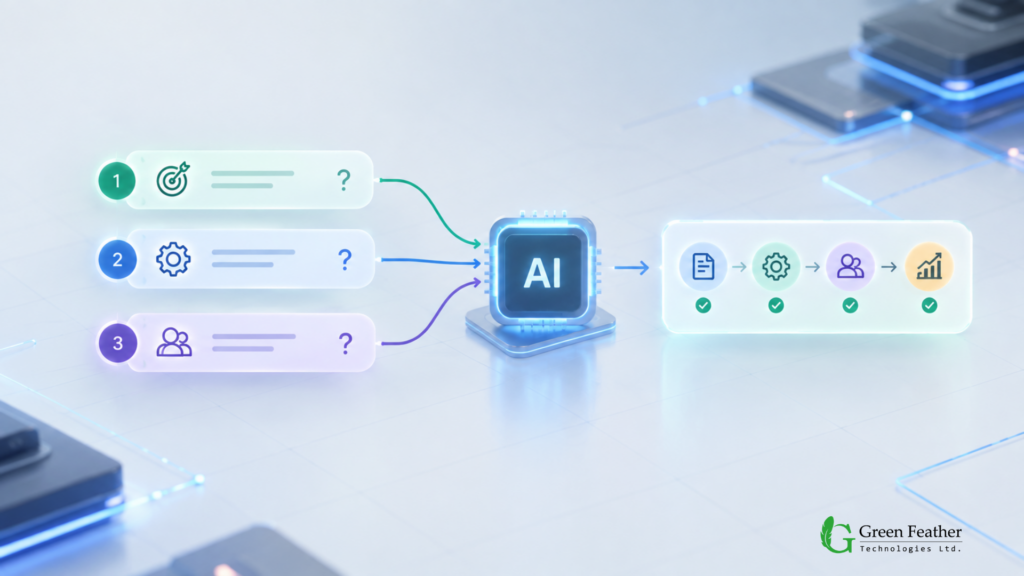
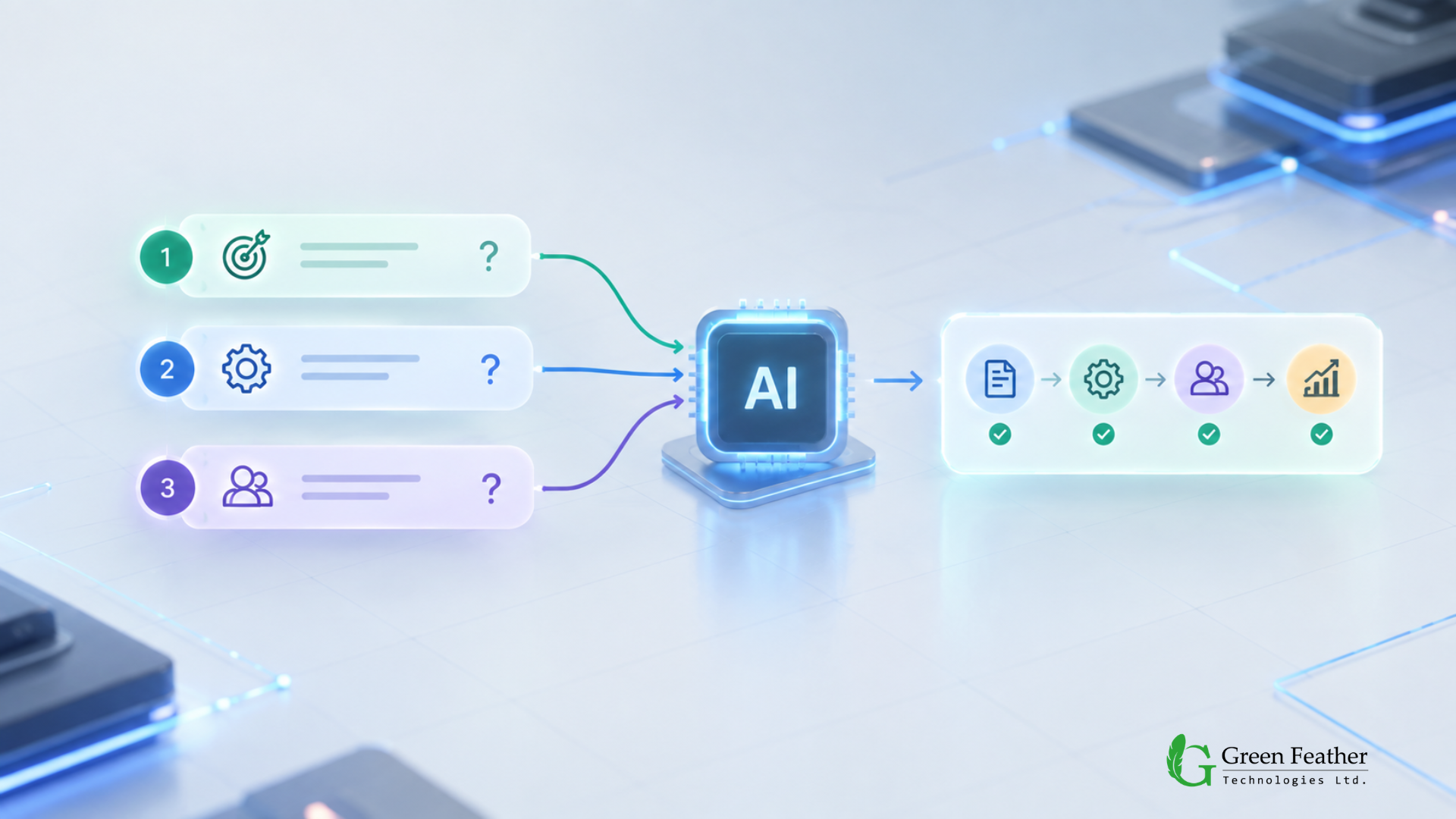
Three questions before adding AI to a process

- What outcome are we trying to improve?
Starting with “where could we use AI?” encourages experimentation without necessarily connecting it to something the business measures.
Define the outcome first: faster turnaround, lower error rates, lower cost per transaction, better customer response times, more capacity from the existing team.
The technology should support the outcome, not become the outcome.
- Which workflow is actually constraining it?
Find the real bottleneck, not the most visible task.
It may be a slow approval cycle, duplicated work, an information handoff between teams, inconsistent inputs, or a role that has accumulated too many responsibilities.
Trace the problem through the process until you find the step that is genuinely limiting performance.
- What changes when AI enters the workflow and how will we know it worked?
This is the question organizations most often skip.
When AI takes over part of the work: does the previous approval still make sense? Does the role responsible need to change? Who owns the final output? Which decisions still require human judgment? Are there steps that can now be removed entirely?
And define the measure before implementation. A dashboard showing more AI usage does not mean the business is performing better. Measure turnaround time, error rate, conversion, cost, customer response time, or capacity freed for higher-value work.
The hidden operational gap
One reason this problem persists is simple: technology can be changed quickly, and organizations cannot.
A company can purchase a new AI capability in days.
Changing roles, processes, decision rights, accountability, and team structures takes considerably longer.
That creates a gap between what the technology can do and what the organization is actually prepared to change.
The tool is live. People are using it. The pilot looks successful. But the underlying workflow is largely unchanged.
That is not proof that the technology failed. It may show the organization stopped at adoption.
Back Market’s CMO frames this as a leadership gap before it’s a workflow gap.
Closing it takes more transparency about how AI is actually changing the work, and more tolerance for the adaptability that requires, than most organizations have built up yet.
The tools move faster than the trust needed to redesign around them.
Workflow redesign is a people decision
Here’s what tends to surface once a business starts redesigning workflows around AI rather than simply inserting it.
- Roles change.
People spend less time executing repetitive work and more time reviewing, orchestrating, deciding, and improving the process.
- Ownership changes.
When several steps change, someone needs to own the end-to-end outcome rather than an isolated task.
- Approvals change.
A review step that existed because information was difficult to produce may no longer be necessary.
- Skills change.
Teams may need stronger judgment, process design, and data literacy rather than training on another tool.
- Capacity changes.
Automation may create capacity, but the business still has to decide where that capacity goes.
Each of those raises the same underlying question: who should be doing this work now?
The AI conversation rarely answers that. It’s answered by a broader operating-model decision one that determines how the business is actually structured to do the work going forward.
GFT’s view on where this leads
Put together, the L’Oréal, Zillow, and Back Market examples point to the same place: AI created value only once the work around it changed skills rebuilt at L’Oréal, roles and approvals restructured at Zillow, leadership becoming more transparent about the shift at Back Market.
In each case, the technology was necessary. It wasn’t sufficient on its own.
That’s the lens GFT brings to this conversation. The gap between AI capability and business impact isn’t really a technology gap.
It can become an operating-model and workflow problem: unclear ownership, approvals that no longer make sense, roles that haven’t caught up with what the tool now does.
Naming it that way doesn’t hand a business the answer.
But it does point to where the answer has to come from: the operating model, not the next tool.
Whether that means retraining, restructuring, or bringing in outside capacity is a decision every business has to make on its own terms, shaped by its own constraints.
What matters first is recognizing that it is a decision that workflow redesign forces into the open, whether or not the organization is ready for it.
A framework for evaluating an AI opportunity
Before introducing AI into an important process:
Step | Question |
Outcome | What business result needs to improve? |
Bottleneck | Where is the current workflow restricting that result? |
Ownership | Who is responsible for the outcome today? |
Human role | Where is judgment still required? |
AI role | Which tasks can AI perform reliably? |
Workflow change | What steps, approvals, or handoffs should change? |
Capacity | What happens with the time or capability created? |
Measurement | Which metric will prove the new process is better? |
This also helps prevent a common mistake: automating a process simply because it exists. The goal isn’t to make every existing step faster. It’s to determine whether the process should still work the same way.
The real question
AI adoption is an important starting point. But the questions that matter now are slower to answer than “which AI tool should we buy?”
Which business outcome improved? Which workflow changed? Which bottleneck disappeared? Which responsibilities shifted? What capacity was created, and where did it go?
Those questions are much closer to the one executives ultimately care about: did the business actually get better?
The value doesn’t come from the tool. It comes from being willing to examine the work itself, redesign the workflow around the new capability, and decide deliberately how people, technology, and processes should fit together.
Operate with clarity. Decide with confidence.