
Most businesses focus on a single question these days: Which AI tools should we buy?
With endless options promising faster results, lower costs, and minimal effort, it’s a fair question. Yet despite massive investments, many organizations struggle to get actual value and end up blaming the tools.
The tools aren’t the problem. Businesses earning high ROI from AI aren’t necessarily using fancier tech. They simply have cleaner operations, such as documented processes, reliable data, clear ownership, and genuine accountability. AI merely speeds up their execution.
So, the real question shouldn’t be “Which tool should we buy?” but “Are our operations ready for AI?”
Why Some Businesses Win With AI While Others Burn Money
If success depended on selecting the right platform, then every business would succeed with the same results. They aren’t. Some organizations scale AI across departments while others abandon projects after months of burned budget.
The difference isn’t intelligence, budget, or access to superior models. Enterprise research from Microsoft shows that top-performing organizations, whom they call “Achievers”, share a far simpler advantage: they already know how to run their business.
Achievers combine clear strategy with disciplined execution. They document processes, assign ownership, align leadership, and build reliable systems.
Companies lacking these fundamentals struggle regardless of how ambitious their strategy looks.
Now, you may wonder, “What about the AI native businesses?”
Well, being “AI-native” doesn’t mean they are bypassing the operational discipline. Rather, it means they are building it from day one.
While traditional businesses must retrofit clean data, ownership, and documented workflows into legacy systems, AI-native organizations have the opportunity to design these foundations up front.
The operational principles remain identical: without clarity in execution, even natively deployed AI models have nothing reliable to build on.
So, at the end of the day –
Businesses don’t have AI problems. They have operational problems.
Operational Readiness Isn’t a Checklist. It’s Business Discipline.
“AI readiness” isn’t just about buying software or hiring experts. Long before adopting AI, real readiness starts with a business that clearly understands its own operations.
Microsoft’s research shows that successful adoption relies on operational clarity, not technical prerequisites.
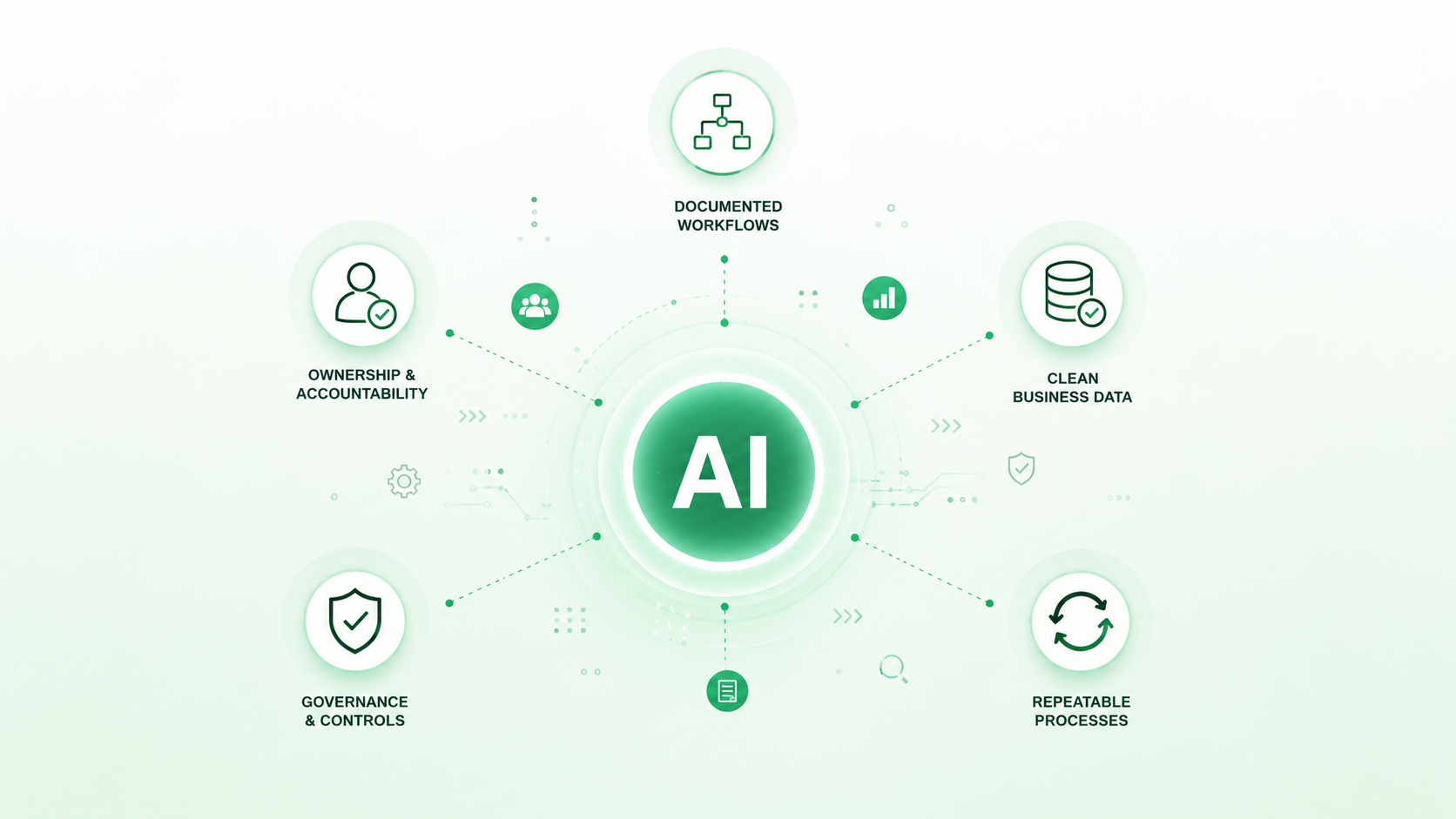
These operational signals answer one core question: Could someone or an AI understand how your business works without guessing? If not, the issue isn’t AI. It’s your process.
AI isn’t replacing discipline. In fact, it’s rewarding it even more.
Documented Workflows
If the business doesn’t have a documented workflow, it will struggle to explain to the AI system how it wants the work done. This often yields inconsistent, low-quality results that require rework again and again.
Clean Business Data
Here’s the thing: AI agents are only as smart as the information they can reach. If your data is a mess, AI will only make mistakes faster. Small inconsistencies that a person would catch instantly get treated as fact instead with AI.
Ownership
Even for an AI system, you need to have someone who owns its operations so they can fix it when needed. Ownership brings accountability. As a business leader, you have to assign owners before deploying any agent. Otherwise, when a project stalls or makes errors, nobody takes charge to fix it.
Governance
Governance has a formal home. The National Institute of Standards and Technology’s AI Risk Management Framework treats governance as the foundational function on which everything else depends.
Without it, no one is watching for the moment a small error stops being small. Setting up clear controls early is what keeps your systems safe and reliable as you scale.
Repeatable Processes
AI agents struggle with inconsistent human habits. If a task changes depending on who performs it, the agent will get confused but will still keep going.
Companies need to standardize their processes and redesign how their employees work. You need a system that is well-defined and stays the same no matter who is in charge. Then, when you add AI, you can speed up the process.
The Additional Layers
Being operationally ready is important, but it’s not a surefire path to AI success. Operational maturity may determine whether the AI can generate value for you. But actually getting value will still depend on the workforce.
A team that is fluent in prompting, output validation, and tool capabilities will innovate faster than a team that isn’t very fluent. This added layer of AI literacy ensures your workforce extracts the most value from the AI systems you implement.
Next comes employee adoption. This is where your employees begin integrating AI systems into standardized, routine workflows, moving beyond surface-level use.
So, think of it like this –
Operational readiness is the foundation, AI literacy is the added layer that makes the workforce capable of extracting value, and employee adoption is the layer that ensures you get the most value out of the AI system.
AI Doesn’t Create Chaos. It Accelerates It.
One of the biggest misconceptions surrounding AI is that it introduces new risks into a business. In reality, most of those risks already existed.
AI simply removes the human ability to quietly compensate for them.
Where people slow down, ask questions, and rely on experience, AI follows instructions exactly as written. That consistency becomes incredibly powerful when the underlying process is strong.
But when the process is weak, the same consistency turns small operational flaws into organization-wide problems.
That’s why AI feels transformational for some companies and disastrous for others. The difference isn’t AI. It’s operations.
Customer Support
In customer support, you can easily notice AI being that nuisance when it comes to executing a bad process with confidence.
For example, when a person routes tickets manually, an unclear escalation path is not that big of a deal because they can use judgment to figure out where something belongs.
Whereas an AI agent routes it with confidence but doesn’t have any clarity. It just follows the process without judgment. While this might be faster, you are simply ending up with wrong data.
Marketing
AI magnifies a weak marketing strategy by producing bad content at large scale. The State of AI in Business 2025 report found that 95% of organizations get zero return on large AI investments, most of which are spent on marketing and sales.
For instance, take a team running ad campaigns without a clear target audience. A human marketer will usually pause, notice the lack of engagement, and adjust the strategy.
An AI tool doesn’t stop to question the strategy. It will generate hundreds of generic emails and ad variations in seconds. It executes a bad plan with high efficiency. You get plenty of content out the door, but it yields zero return and wastes your budget.
Finance
Finance runs on reconciliation, which is highly dependent on consistent underlying data. If the data is poor, the business gets in big trouble. According to Gartner, poor data quality can cost a business $12.9 million annually.
Consider vendor management as an example. If a vendor’s name is spelled three different ways across your spreadsheets, a human accountant uses common sense to realize it’s the same company.
An AI agent lacks that real-world context. It will treat them as three separate entities, process the numbers blindly, and push the mistakes forward. Instead of saving time, you get duplicate payments and inflated totals in record time.
Software Development
Coding assistants show this exact risk in software engineering. GitClear’s 2025 analysis of 211 million lines of code found refactored code dropped from about 25% of all changes in 2021 to under 10% by 2024. Because AI is increasingly used to write code.
When a human developer takes shortcuts, strong peer reviews usually catch the mess and force the team to clean up the code before release.
An AI coding tool doesn’t care about long-term structure. It will copy existing patterns and spit out thousands of lines of code instantly. If your team already lacks review discipline, the tool won’t fix that habit. You simply end up with fragile software full of technical issues, just built fast.
Before Buying AI, Audit Your Business
The best AI strategy actually starts long before you even buy AI.
It starts with assessing your operations first, then considering the technology. Technology assessments usually begin with feature comparisons. Operational assessments begin with different questions.
Questions that reveal whether AI has a stable system to operate inside. Instead of asking which platform has the best capabilities…
Ask whether your business has given any platform the conditions it needs to succeed.
Question | Why it matters |
Is the workflow that AI would touch actually documented, start to finish? | Without a documented process, AI produces inconsistent and poor-quality results at scale. |
Does everyone involved know who owns each decision in that process? | Ownership gaps are where unclear-value AI projects get canceled. |
Can the systems and people involved actually access the data the AI would need? | If data can’t be accessed, AI gets confused across the different business operations. |
What happens when the AI gets it wrong? | There needs to be someone who reviews what AI does, figures out the issue, and fixes it. |
What does success look like in numbers, and who’s checking in 90 days? | KPIs can help identify whether the AI is delivering value. |
Why Operational Readiness Changes Everything
Once operational foundations are in place, AI stops becoming an experiment. It becomes an accelerator.
Projects launch faster. Automation produces consistent results. Employees trust the outputs. Leaders can measure business impact instead of debating whether AI “works.”
Organizations seeing the greatest value from AI rarely begin with better technology. They begin with better operations.
Gartner predicts more than 40% of agentic AI projects will be canceled by the end of 2027, mainly due to unclear value and rising costs. The reason is the lack of operational readiness by most businesses.
Here’s how things can turn around –
1. Deployment Moves Twice as Fast
Cleaning up your operations first lets you skip the endless delays of using AI to produce bad results. You aren’t wasting time mid-launch trying to figure out who owns the data or who signs off on approvals.
If we go back to the Microsoft report, you will see achievers deploy AI agents in under six months on average. On the other hand, visionaries take nine months or longer.
That extra time visionaries take is spent on fixing basic operational issues that they should have resolved up front. As a result, Achievers expect to scale AI 2.5 times faster than slower adopters.
The difference between them is operations. Both have strategy, but one has operations by its side.
2. Workflow Redesign Before Workflow Automation
Pasting AI onto an outdated workflow rarely creates real value. If you keep your old process as it is, the AI only speeds up a single step while the rest of it stays slow. Eventually, you aren’t getting any added value. Instead, you get added flaws.
Focusing on operational readiness helps you fix the system by rebuilding the entire workflow. A documented workflow gives you the basics for setting up your AI properly so your operations deliver consistent results every time.
That’s what the top-performing firms are doing as well. They are 7 times more likely to document their key processes before automating anything. Not only that, but half the achievers also reimagine employee roles and career paths for an AI-first model to stay prepared.
3. Data Moves Freely Without Hidden Blockers
For AI agents to work at their highest ability, you have to make sure the data is accessible across all departments. If your internal systems operate in fragmented groups, the agent stalls out or makes bad calls based on partial data.
When you are operationally ready, you have a clean, connected data foundation. Assigning clear data owners and unifying your files gives the AI a reliable source of truth. This allows your operations to feed the system accurate information every single time.
Most AI high performers treat data as core infrastructure rather than an afterthought. By establishing clear data ownership early, they ensure their AI agents always have the clean foundation needed to scale.
4. Risks Get Managed Before Errors Scale
If an agent operates without proper monitoring, any minor mistake can be repeated throughout your entire workflow. Eventually, you lose control over automated tasks. Instead of building trust, you end up with compliance issues and customer headaches.
It’s best to establish governance long before you go live. Setting up human review steps and defining clear escalation paths keeps your automated processes safe. A solid control structure ensures your operations remain reliable even as you scale.
Businesses that succeed with AI assign dedicated executive sponsors and set strict safeguards before rolling out any tool.
Bottom Line
For years, businesses believed digital transformation was about adopting better technology. AI is proving something different. Technology is becoming increasingly accessible. Operational excellence isn’t.
The organizations creating measurable value with AI aren’t succeeding because they found a better model. They’re succeeding because they built businesses capable of supporting intelligent systems long before those systems arrived.
That’s why AI isn’t replacing operational excellence. It’s rewarding it.
So before asking,
“Which AI platform should we buy?”
Ask the question that will determine whether any platform succeeds at all.
“If AI executed our business exactly as it operates today, would we be proud of the outcome?”
Because AI doesn’t transform broken operations. It scales them.
Frequently Asked Questions
Is it necessary to pause current AI projects while fixing operations?
Not necessarily. You do not need to halt every initiative. Instead, narrow the scope of active tools to simple, fully standardized tasks. Clean up complex workflows in parallel before expanding automation further.
Can AI tools help us document and clean up our messy processes?
AI can speed up documentation by organizing rough notes or transcribing interviews. However, it cannot fix broken business logic. Leaders must still define the rules, eliminate shortcuts, and establish clear accountability.
Who in the organization should lead the operational readiness assessment?
Operations or line-of-business leaders should lead the review, not the IT team. Tech teams manage software deployment. Department leaders understand how daily work actually gets executed on the ground.
How long does an operational cleanup take before deploying AI?
A targeted review usually takes two to four weeks per workflow. You do not need to fix the entire company at once. Focus strictly on the specific process you intend to automate next.
What is the biggest operational red flag before buying an AI tool?
Heavy reliance on tribal knowledge. If a process relies on unwritten rules, intuition, or personal habits, AI will fail instantly. Document those implicit steps before handing the work to an automated system.